Presented at Atlantia KASF 2024 in the Barony of Tir-y-Don
Spinning natural fiber into thread and yarn has been a vital step in fabric production since humans started weaving cloth. Animal fiber, linen from flax, cotton and silk have all been used. After the fiber has been harvested, cleaned and prepared it needs to be spun into threads that can be plied into thicker strands before knitting or weaving into fabric. Presented today are tools from the Baltic region of Europe for spinning fiber.
Distaffs
A distaff was used to hold the prepared fiber for spinning. A number were found in the Oseberg burial mound/ship find in Norway in 1903.
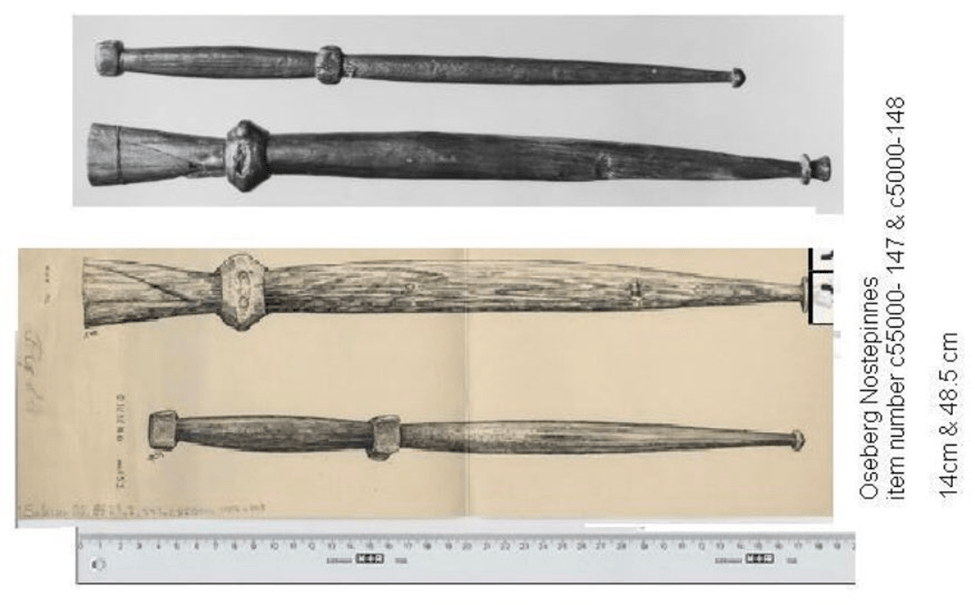
Note that these are labeled, incorrectly as nostepinnes/nostepindes. Because of the shaft shape and the knob on the end these can’t be nostepinnes. The knob is used to hold the cord that is used to hold the fiber to the distaff.
Many illuminations show women using a belt distaff which is another style that is basically a long stick that the spinster stuck into her belt as opposed to holding in her hand. I have also included one 16th century image attributed to Campi that shows a woman with a handheld distaff.
They could have been carved or turned on a spring-pole lathe. Most likely they were made from freshly harvested, local wood. The ones I am presenting were turned on a modern lathe using red oak. I am also presenting two nostepinne for comparison
Baltic / Bugarian Style Spindles
According to the Journal of Experimental Archaeology typical historic spinning was done with an oval shaped spindle that was held in the hand away from the distaff.
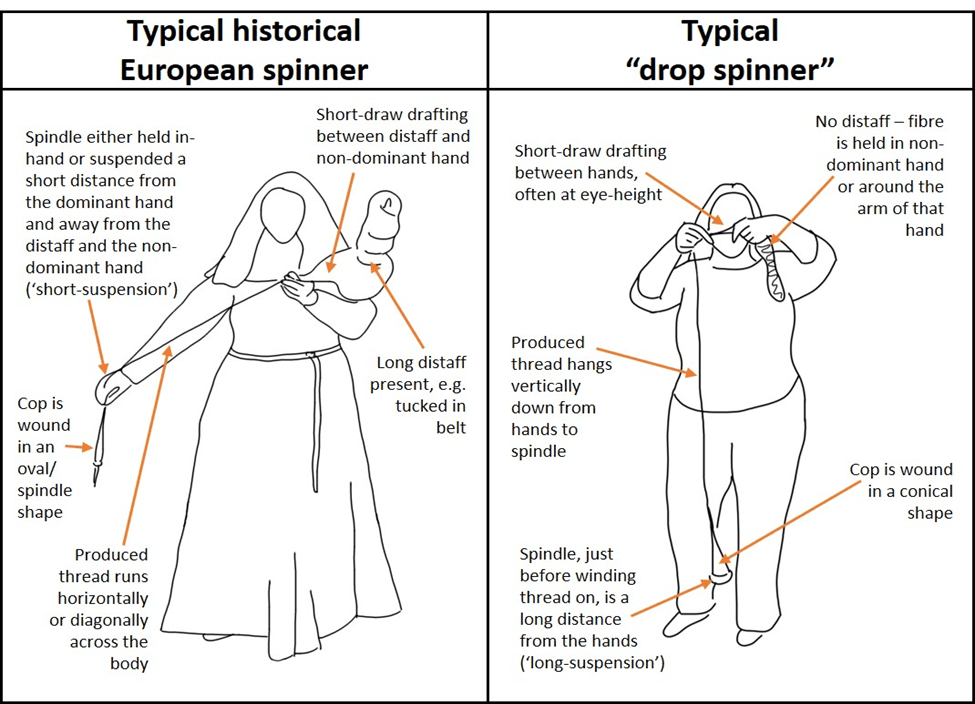
An article at the page of the University of Innsbruck in Austria has pictures of antique, but probably not SCA period spindles, but they are similar to the ones described in the EXARC article.
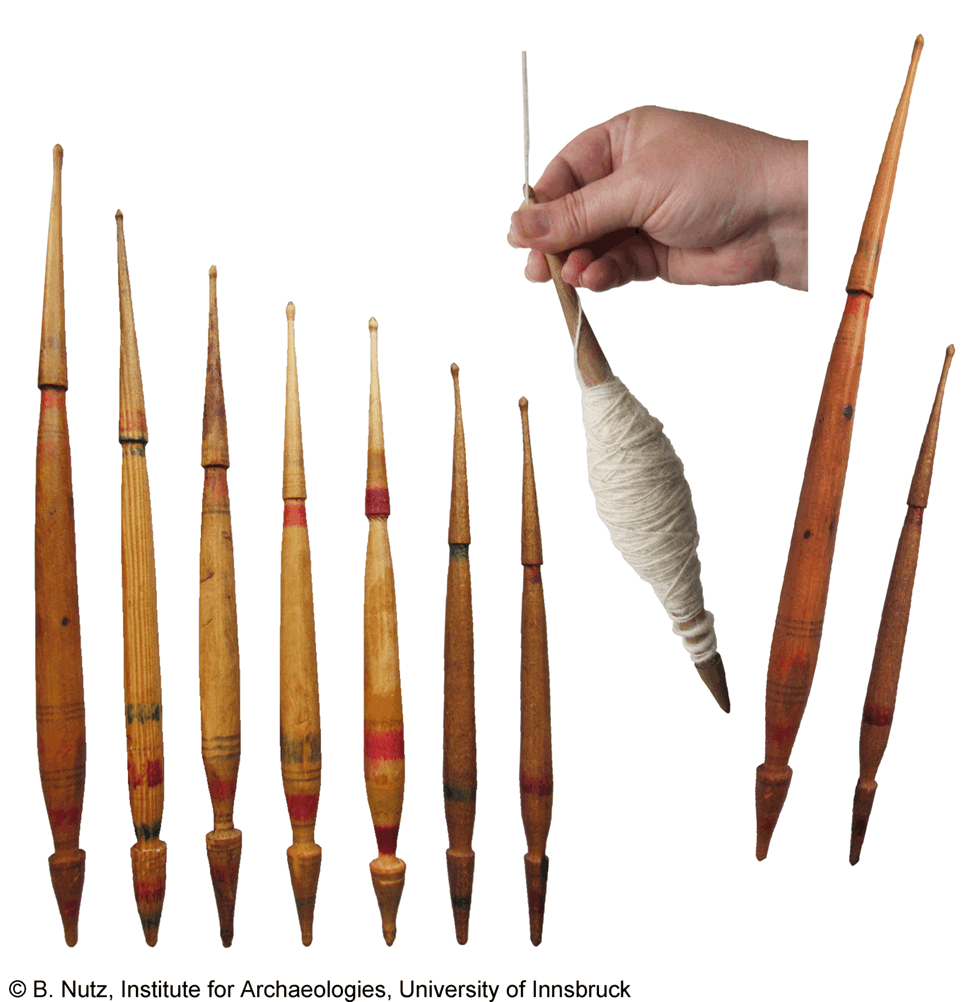
According to the University article spindles ranged from just over 10 inches to just over 16 inches. Depending on size they were held in the hand, the shorter ones, or supported in a dish or on the ground, the longer ones. Some spindles could have whorls added to convert them to drop spindles.
I am presenting spindles in various lengths out of various woods that I had in my shop including maple and oak. The spindles with the removeable whorls are maple with oak whorls. For the long, supported spindles, I made two conjectural support bowls from oak. These have a wide, shallow bowl to allow the spinner to hold the spindle at different angles. They have a cove turned into the side allow it to rest comfortably against the spinner’s foot if used on the ground. They are deliberately left weighty to keep the bowl from moving.
Pictures of the items presented will be added later.
Post presentation addendum. I was contacted about making French Style spindles which are similar to the Baltic/Bulgarian style but instead of a knob at the top they have a longer cone with a spiral cut in guide the spun fiber. Pictures of this also forthcoming.
 Æduin of Skye